Founder(s):
Zsámbok Ákos 
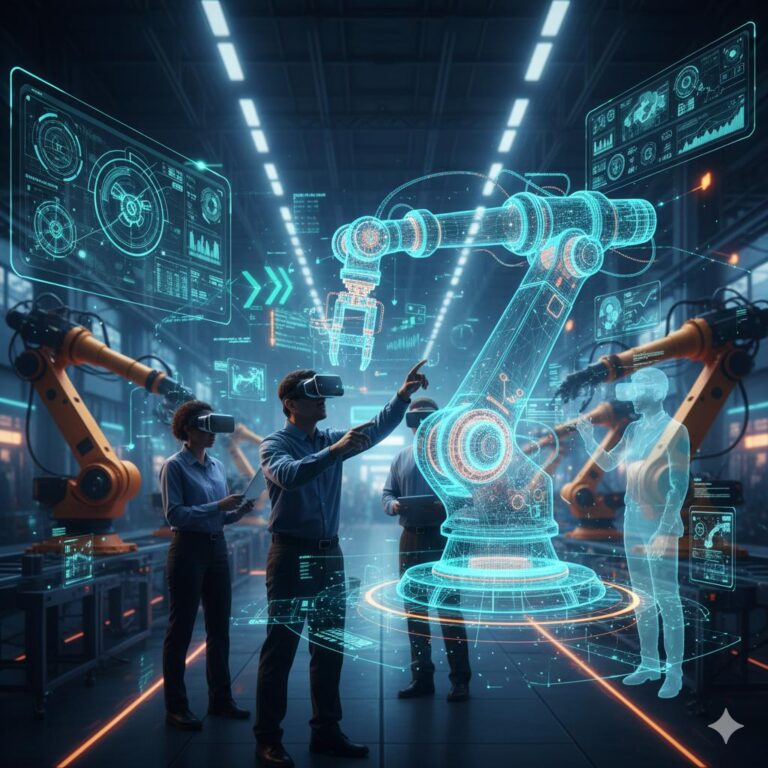
The thesis examines the application of simulation technologies and digital twins in industrial robotics, with a particular focus on the Unity development environment. Simulation enables the safe, cost-effective, and flexible testing of industrial robots without the need to use physical equipment in every case.
The research focuses on the geometric modeling of a Mitsubishi RV-3SB industrial robot. The Denavit–Hartenberg convention is used to develop the robot’s forward kinematic model, while a decomposition method is applied to create the inverse geometric model. The mathematical models are implemented in the Unity environment using the C# programming language, enabling three-dimensional visualization of the robot and the development of various control functions.
The thesis presents the concept of digital twins and explores the possibility of communication between the virtual and physical robot via an Ethernet connection. Through the integration of Unity and the Robot Operating System (ROS), real-time robot control and, in the future, the development of machine-learning-based algorithms can also be supported.
The study also examines the application of virtual reality (VR) and augmented reality (AR) technologies. Particular attention is given to the Meta Quest 3 VR headset and the development of VR and AR applications in Unity. The solution allows users to interactively examine and control the digital model of the robot within a virtual environment.
Overall, the thesis presents the development of a Unity-based digital twin that supports the modeling, visualization, interaction, and potential real-time control of industrial robots. The approach can contribute to making industrial robotics education, development, and testing more efficient and safer.