Outstanding Student Work and a New Award – Most Innovative Thesis 2026 Awards Presented
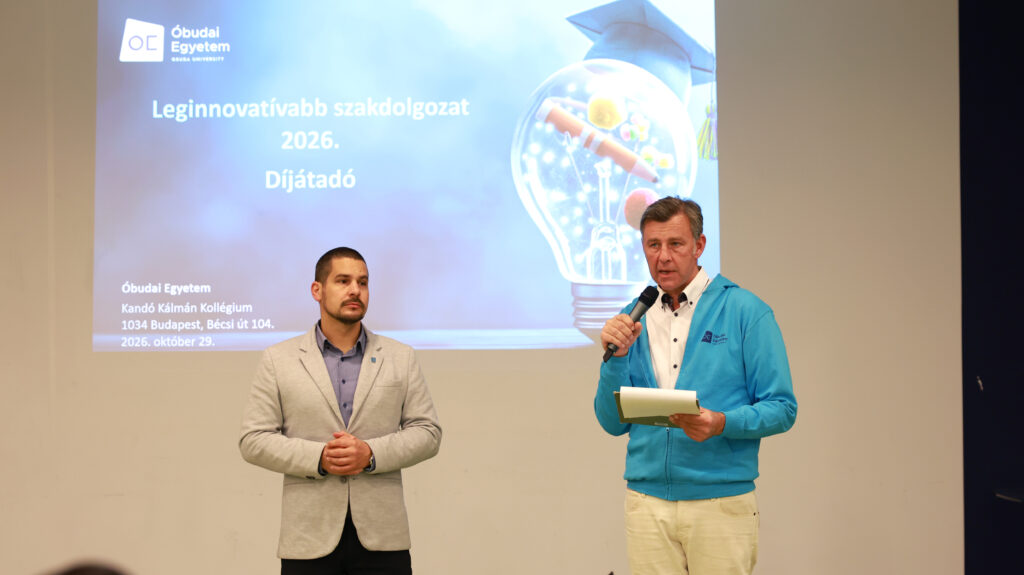
The jury selected the winners of the Most Innovative Thesis Competition 2026 from more than thirty submissions. The awards were presented on 29 October at Óbuda University’s XVIII. INNOMEET event. This year also marked the introduction of the Social Innovation Special Award, recognising work that seeks to create positive social impact.
The Most Innovative Thesis Competition recognises outstanding, innovation-driven student work and highlights the potential of student research and development. This year’s call attracted more than thirty valuable submissions, whose quality and diversity made the jury’s task particularly challenging.
The submitted theses demonstrated creativity, dedication to research, and an understanding of practical challenges. They shared a common ambition: to turn knowledge into new solutions—developments and concepts that address real needs and offer potential for future application.
Recognition and Support for the Next Steps
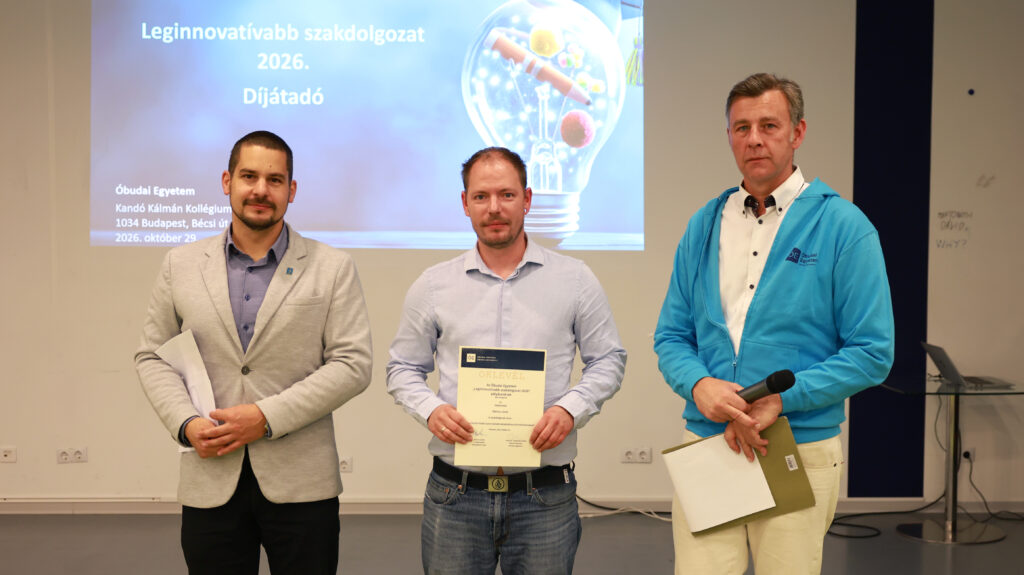
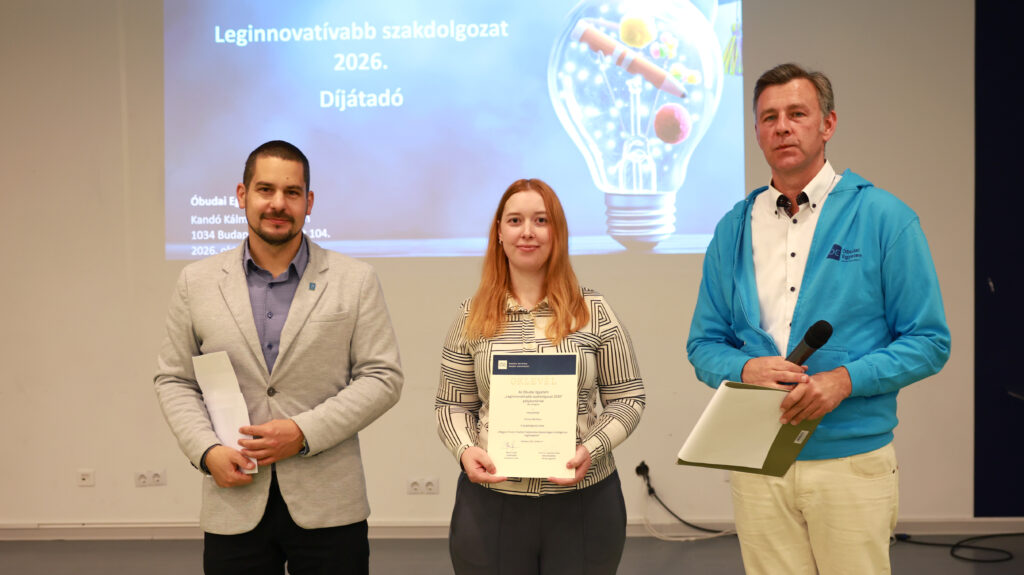
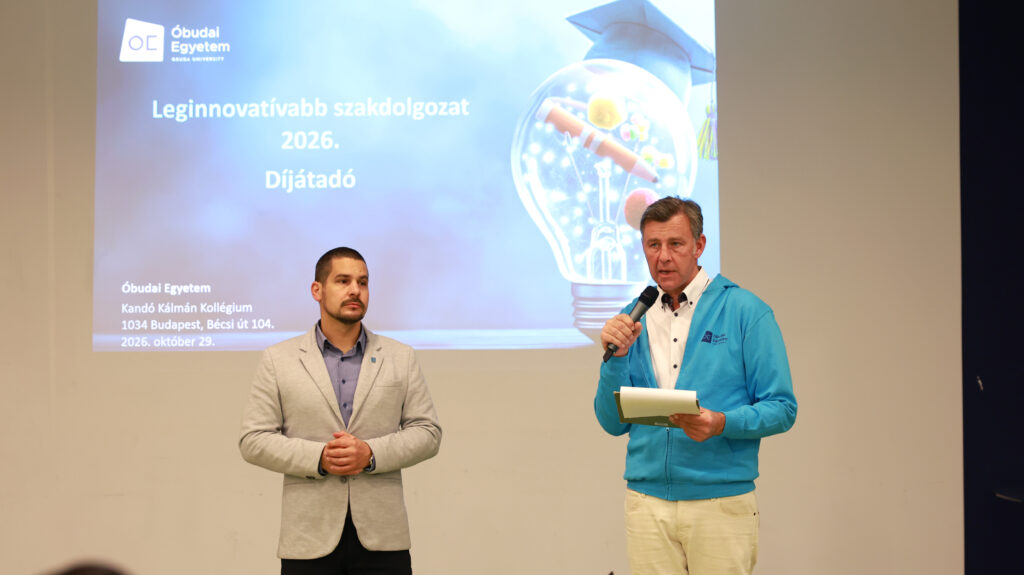
The top three entries in each of the competition’s two categories received awards. The honours were presented by Dr Tamás Haidegger, CEO of Initium Venture Labs Zrt., and László Bacsa, Head of the Innovation Office.
During the ceremony, the presenters emphasised that, alongside recognising achievement, the university actively supports young people whose research and development work contributes to sustainable and creative solutions for the future. Completing a thesis can therefore also mark the beginning of a longer journey in research, development, or innovation.
A New Special Award for Work Addressing Societal Challenges
An important addition to this year’s competition was the establishment of the Social Innovation Special Award. The new distinction was inspired by submissions that combined academic excellence with a commitment to addressing significant societal challenges.
The award reflects the view that the value of innovation is also measured by its impact on people’s lives: improving quality of life, helping to reduce disadvantages, or making support more accessible to those who need it.Presented for the first time this year, the award honoured a thesis that puts expertise and creative thinking at the service of an important social cause. With the introduction of the Social Innovation Special Award, these efforts will continue to receive particular attention in future editions of the competition.
Award winners in the MSc category
🥇 1st. place [250k HUF prize]: Barbara Simon – Neumann János Faculty of Informatics, Biomatics and Applied Artificial Intelligence Institution
“Hungarian Medical Chatbot Development Using Artificial Intelligence”
Barbara developed a Hungarian-language, AI-powered medical assistant that draws on a medical reference book to answer health-related questions and also supports the analysis of images of skin lesions. The system uses several specialized AI agents working together to generate and check its responses, while bringing health information, image analysis, and medical appointment booking together in a single interface.
🥈 2nd place [150k HUF prize]: Martin Ferenc Dömény – Neumann János Faculty of Informatics, Biomatics and Applied Artificial Intelligence Institution
“In silico optimization of chemotherapy”
The thesis focused on developing an automated therapy optimization method that uses a mathematical model of tumor dynamics to generate personalized treatment strategies.
🥉 3rd place [100k HUF prize]: László Márkus – Alba Regia Faculty, Institute of Geoinformatics
“Automated Detection of Pavement Defects from Drone Imagery”
The central objective of the thesis was to replace traditional, time-consuming, and subjective road condition surveys with an automated, high-precision workflow based on drone imagery.
Award winners in the BSc category
🥇 1st place [250k HUF prize]: Julianna Bódog – Neumann János Faculty of Informatics, Software Engineering Institute
“Texture baking from high poly models to retopologized low poly versions”
Julianna’s software helps digital applications and video games display visually impressive, highly detailed objects while requiring less computing power. A particular strength of her solution is that it can work alongside different 3D design programs and harnesses the graphics card’s processing power to speed up model preparation.
🥈 2nd place [150k HUF prize]: Dániel Edmond Tóth-Szegő – Neumann János Faculty of Informatics, Software Engineering Institute
“Creating a Wood Marquetry Image from a Photograph Using Images of Available Veneers”
The thesis focuses on developing software that uses image processing techniques to automatically generate wood marquetry designs from digital images, using photographs of the available wood veneers.
🥉 3rd place [100k HUF prize]: Arnold Szarka – Ybl Miklós Faculty of Architecture and Civil Engineering, Institute of Architecture
“Biotextiles in Hegyalja”
Arnold focused on establishing a biotextile production facility and an associated visitor centre that would transform a winemaking by-product into textile material.
Social Innovation Special Awardj
🏆 [100k HUF prize]: Attila Stankovics – Ybl Miklós Faculty of Architecture and Civil Engineering, Institute of Architecture
“Heritage and Integration Roma Collage for Advanced Studies School in Tokaj”
Attila developed an architectural concept for a school with residential accommodation in the Tokaj-Hegyalja region that would support education and social mobility for disadvantaged young people, particularly Roma youth. A key strength of the project is its integration of housing, practical training, cultural heritage preservation, and community life into a coherent whole, preparing young people for further education and employment opportunities linked to the local economy.
Photos
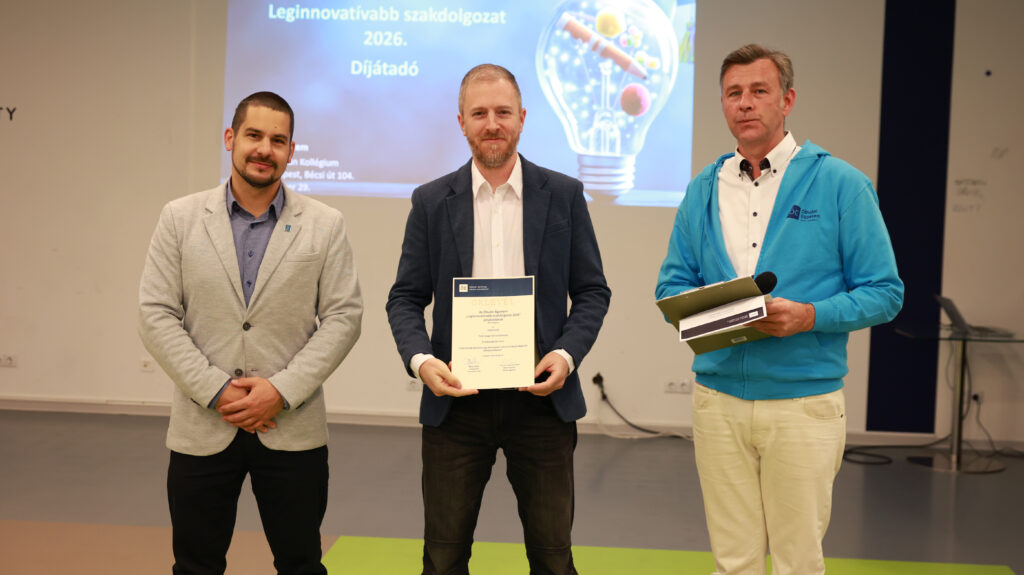
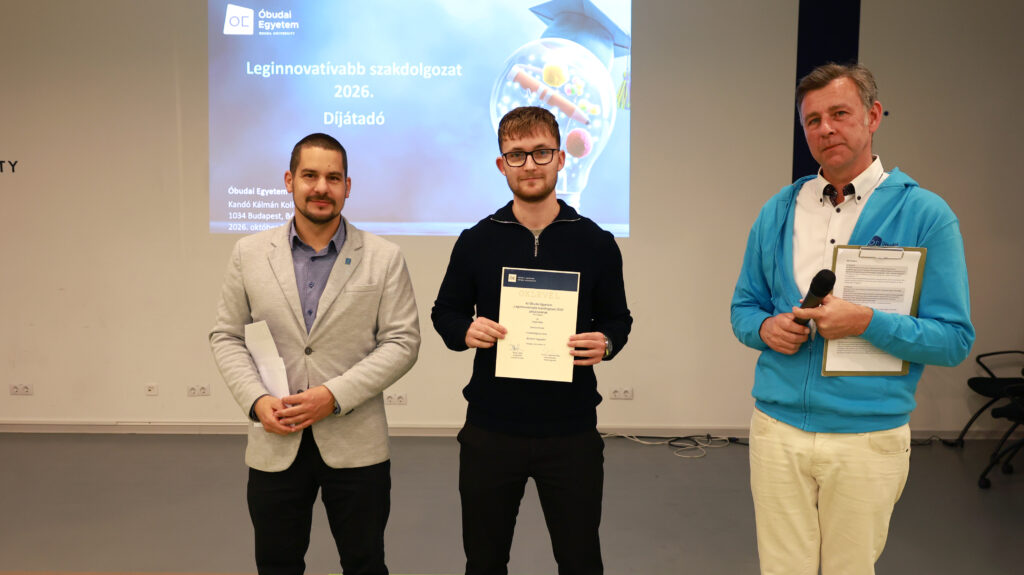
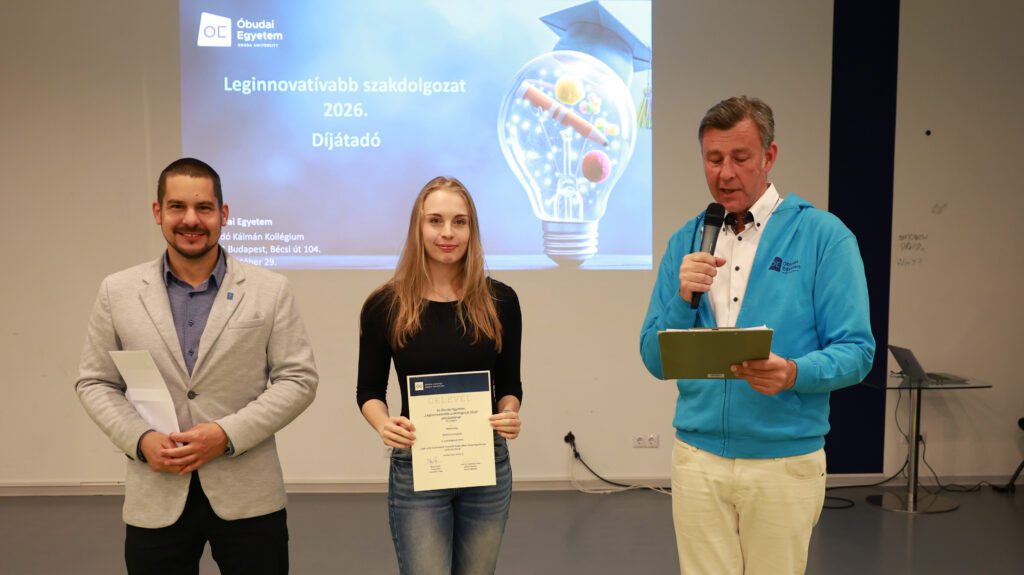
Congratulations to all the award winners, and thank you to every applicant whose work contributed to the achievements of Obuda University’s innovation community!